











 137
137
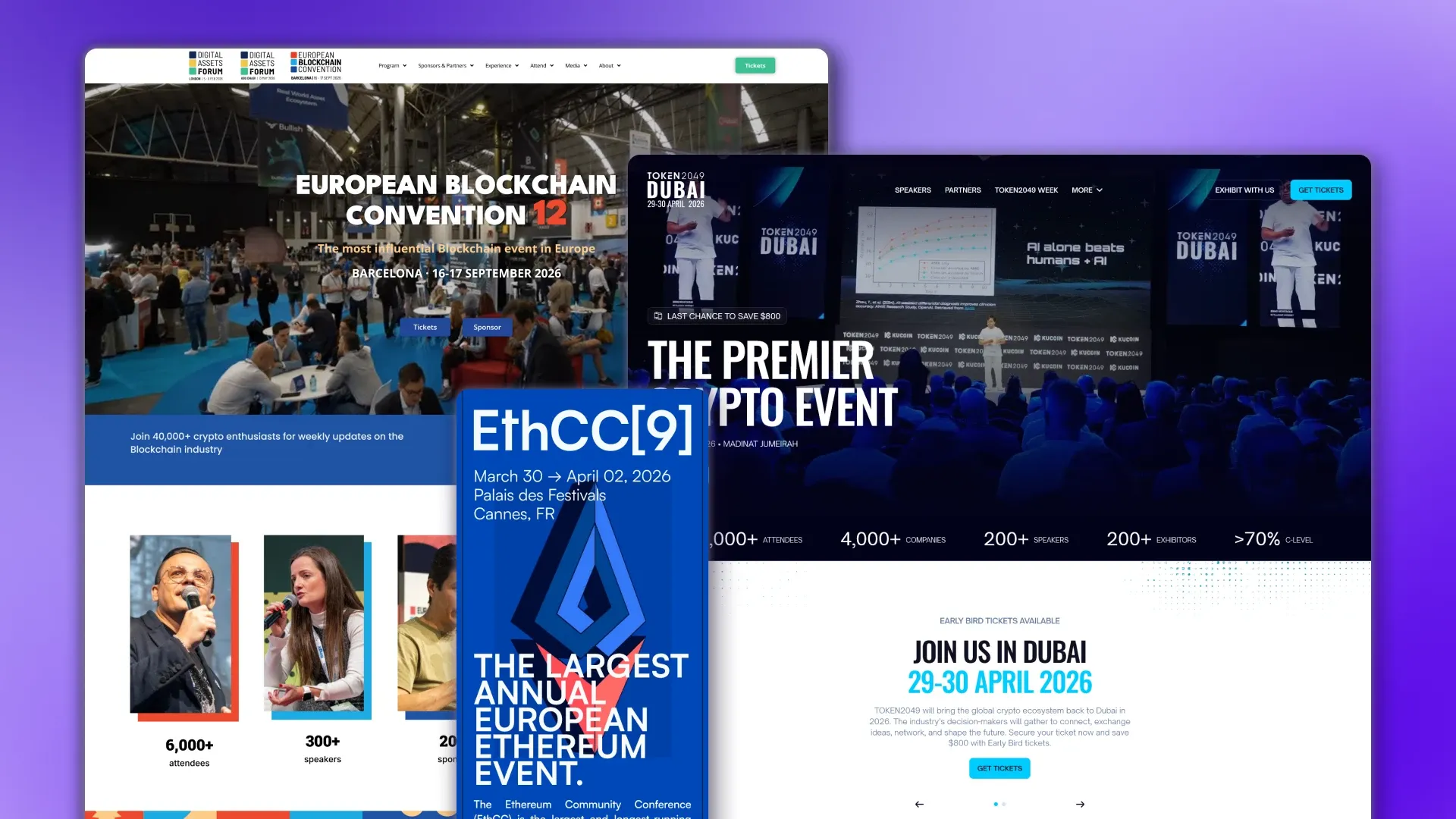
In recent weeks, the market has split experts into two camps: some expect a new growth cycle, while others are preparing for a difficult period. Reports from Coinbase Institutional and Grayscale suggest that the industry is entering a new phase: ETFs, tokenization of real-world assets, and inflows of institutional capital are making the market more mature and resilient. At the same time, other experts warn that macroeconomic conditions remain tense, liquidity is unstable, and therefore 2026 may bring not euphoria but a harsh correction.
In other words, the market is at a crossroads – either this is the foundation for the next growth cycle, or a year of reset and capital reallocation. At such moments, it is especially important to look not only at charts, but also at the industry agenda: where funds gather, what regulators are discussing, and which technologies receive attention and investment.
It is at major crypto conferences that signals appear which later turn into full-fledged market trends. But it is important to understand that events themselves differ: some focus on technology and development, others on regulation and politics, and others on investment and capital.
In this article, we will help you understand which events in 2026 truly influence the market and at the same time fit your specific goals – whether it is fundraising, product development, or working with regulators – so you can more accurately assess where the industry is heading and where exactly it is worth being in person.
📍 February 10–12, 2026
Consensus Hong Kong
Hong Kong, China
Consensus Hong Kong is the intersection point of the crypto industry and traditional finance in the APAC region. If you want to understand how crypto integrates into Asian markets and what rules of the game are being formed in the region, you will hear it here firsthand.
Topics include regulation, cross-border markets, tokenization of real-world assets, and institutional investment. The format is large-scale, international, and quite business-oriented. In the hallways, meetings take place that are often more important than the panels themselves.
For companies with global ambitions or plans to enter Asia, this is one of the few venues where you can simultaneously meet regulators, funds, and infrastructure partners.
Pros: strong institutional focus and global reach.
Cons: high participation costs and intense competition for attention.
Who should attend: companies working with international capital or entering APAC.
Life hack: Consensus Hong Kong traditionally includes, in addition to the main panels, numerous side events and satellite gatherings where in-depth discussions and closed meetings with investors and industry leaders take place. Plan your visit so that you participate both in the main program and in the most relevant side events (networking sessions, thematic roundtables, and informal meetings), as this is often where the most productive business conversations happen.
📍 February 18–21, 2026
ETHDenver
Denver, USA
ETHDenver is about speed and practice. The main driver of the event is the hackathon and a dense program for developers. Here, L2s, infrastructure, smart contracts, and scaling are discussed not in theory, but in a “formed a team – built a prototype” format.
The audience includes developers, Web3 startup founders, and protocol teams. This is a place where ideas are quickly tested, technical partners are found, and teams are formed. In spirit, ETHDenver is dynamic and a bit chaotic, but very productive.
Pros: strong developer environment, lots of hands-on work, and fast collaborations.
Cons: little institutional capital and almost no regulatory agenda.
Who should attend: teams in the build stage, L2 projects, Web3 startups that need developers and technical partners.
Life hack: if you are going to ETHDenver, plan your time around the hackathon and networking sessions in advance and actively use internal communication channels (such as the event app or Discord group). At past conferences, participants noted that the most valuable connections were made through pre-scheduled meetings and hackathon participation, rather than random conversations at booths or in hallways.
📍 March 30 – April 2, 2026
ETHCC (Ethereum Community Conference)
Cannes, France
ETHCC is a more structured and “engineering-focused” venue. There is less hackathon chaos and more systematic talks. The program focuses on Ethereum architecture, scaling, privacy, and protocol development.
The audience consists of technical leaders, researchers, and infrastructure teams. If ETHDenver is where prototypes are often born, ETHCC is where people discuss what the ecosystem should look like in a few years.
Both conferences are important for Ethereum, but they serve different purposes: one helps you build fast, the other helps you understand deeply.
Pros: high level of technical discussions and a strategic view of Ethereum’s development.
Cons: fewer opportunities for fundraising and media exposure.
Who should attend: CTOs, protocol teams, and companies working at the infrastructure and R&D level.
Life hack: study the technical program in advance and select specific tracks. Based on previous years’ formats, several technical streams run in parallel, and without prior planning it is easy to miss key talks. It also makes sense to schedule meetings in advance – the audience here is mainly technical, and spontaneous “investor” contacts are rare.
📍 April 15–16, 2026
Paris Blockchain Week
Paris, France
Paris Blockchain Week has firmly established itself as one of Europe’s key platforms for dialogue between business and regulators. In 2026, the program includes tokenization, banking integration, fintech, Web3 infrastructure, and the European regulatory agenda.
This is a hybrid format: there are both technological tracks and institutional discussions. Paris is gradually becoming a place where Europe’s strategy toward digital assets is being shaped.
For companies focused on the EU, this is an opportunity to understand where regulation is heading and which niches are opening up.
Pros: strong European regulatory agenda and a high level of speakers.
Cons: the format overlaps significantly with other European events, so without a clear goal the trip may not deliver unique value.
Who should attend: companies working with the European market and regulators.
Life hack: if your goal is regulatory contacts or banks, study the list of speakers and partners in advance and reach out to them before the conference via LinkedIn. The event format предполагає many official panels, so spontaneous networking may be less effective than pre-arranged meetings.
📍 April 27–29, 2026
Bitcoin 2026 (Bitcoin Conference)
Las Vegas, USA
Bitcoin 2026 is the largest global conference fully dedicated to BTC. The scale is impressive: tens of thousands of participants, strong media presence, and wide coverage.
Topics include mining, the Lightning Network, institutional adoption, and Bitcoin’s role in the financial system. In recent years, the conference has strengthened its regulatory and political component. Here, not only the technology is discussed, but also its impact on economic policy.
For companies in the Bitcoin ecosystem, this is one of the main indicators of market sentiment.
Pros: huge audience and high media resonance.
Cons: part of the program is shifted toward politics rather than technical depth.
Who should attend: companies in Bitcoin infrastructure, mining, and those working at the intersection of crypto and regulation.
Life hack: keep in mind that the program is traditionally divided into a business track and more technical sessions. If you work in infrastructure or Lightning, check the schedule in advance – the main stages often focus on strategic and regulatory topics.
📍 April 29–30, 2026
TOKEN2049
Dubai, UAE
TOKEN2049 is a conference where capital and business scaling are at the center of attention. Speakers include executives from major exchanges, stablecoin companies, and investment funds. The agenda focuses on liquidity, fundraising, strategic partnerships, and international expansion.
Dubai amplifies the effect thanks to its geography. Players from Europe, Asia, and the Middle East meet on one platform, making the audience truly global. A significant portion of the value is created not only on stage, but also in behind-the-scenes negotiations, where real deals and partnerships are discussed.
TOKEN2049 delivers maximum impact to projects that are already ready to scale and can offer the market a concrete result. If your product is still at an early stage, competing for investor attention will be difficult.
Pros: a large number of active investors and international partners in one place.
Cons: high participation costs and serious competition for audience attention.
Who should attend: growth-stage startups and companies seeking investment or strategic partnerships at a global level.
Life hack: registration for side events and closed meetings is usually separate from the main conference. Based on official practice from previous years, a significant portion of real networking happens at these additional events, so they should be planned in advance.

📍 May 5–7, 2026
Consensus Miami
Miami, USA
Consensus Miami is already CoinDesk’s “flagship” event for the United States. Funds, exchanges, regulators, corporations, and crypto founders who want to be heard meet here.
Organizers claim around 20,000 participants and a large-scale program: from Web3 and AI to digital assets in the banking system. This is more of a business summit than a festival. Many official discussions, little random noise.
By the dynamics, it is clear that the event is increasingly shifting toward a serious B2B format: more institutional content, less “carnival.” In reviews, participants appreciate the concentration of major players but complain about an overloaded schedule.
Pros: strong institutional audience in the US.
Cons: harder to stand out among a large number of projects.
Who should attend: companies focused on the North American market.
Life hack: the event traditionally has separate tracks and summits (for example, institutional sections). Check ticket formats and access to these areas in advance – a standard ticket does not always grant access to all meeting formats.
📍 June 2–3, 2026
Istanbul Blockchain Week
Istanbul, Turkey
Istanbul Blockchain Week is not only a conference, but a full industry week with an expo, side events, and a noticeable festival element. The atmosphere here is more open and dynamic than at classic institutional summits. A strong regional community, an active entrepreneurial environment, and growing interest in crypto in Turkey make the event visible on the EMEA map.
This is a convenient entry point for projects that want to strengthen their position in Turkey, the Middle East, and Eastern Europe. At the same time, it is worth understanding that the focus here is more on audience growth and visibility than on closed-door negotiations with global funds.
Pros: high regional reach, active community environment, good branding opportunities.
Cons: less influence on strategic institutional decisions at the global level.
Who should attend: projects that need to expand their regional presence, strengthen PR, and work with a broad crypto audience.
Life hack: the event includes both the conference and additional activities. If your goal is PR and community reach, consider not only the main program but also the side activities, which often provide more live contact with the audience.
📍 June 11–13, 2026
BTC Prague
Prague, Czech Republic
BTC Prague is one of the most practical Bitcoin events in Europe. More than 90 companies participate in the expo zone, and the core of the program focuses on the Lightning Network, mining, wallets, and infrastructure solutions. This is not about abstract discussions of the future of the industry, but about how specific products work today and how to scale them.
The atmosphere here is more working than ceremonial. There is a lot of live communication, technical discussions, and demonstrations of solutions in action. For European projects, this is a convenient point to strengthen ties within the Bitcoin community and meet teams that are actually building products.
Pros: strong European community and practical focus of the program.
Cons: limited influence on global institutional and regulatory processes.
Who should attend: European Bitcoin projects, infrastructure companies, and product teams for whom real partnerships within the ecosystem matter.
Life hack: the expo zone plays a key role. If you are a product team, it makes sense to allocate time specifically for booth interactions and solution demonstrations, not only stage talks.
📍 September 16–17, 2026
European Blockchain Convention (EBC)
Barcelona, Spain
European Blockchain Convention is one of the most stable and systematic platforms in Europe. It is not a festival or a narrow tech meetup, but a full-fledged business conference with a focus on banks, fintech, regulation, and tokenization.
There are many representatives of European financial institutions, the corporate sector, and infrastructure companies. The format is quite business-oriented, yet not overloaded in scale. This is a convenient venue for working with the European market without excessive competition for attention, as at global events.
EBC is especially valuable because it provides access to real European decision-makers, not just the startup community.
Pros: strong European B2B audience, clear format, focus on regulation and finance.
Cons: less global media resonance compared to Consensus or TOKEN2049.
Who should attend: fintech companies, B2B projects, and those working with European banks and regulators.
Life hack: the audience is more compact than at global events. This increases the chances of high-quality networking, but meetings are best planned in advance, as the format предполагає a dense business program.
📍 December 1–2, 2026
Blockchain Life 2026
Dubai, UAE
Blockchain Life 2026 is an international forum on cryptocurrencies, blockchain, and the digital economy, taking place in Dubai. The event traditionally attracts a wide audience: investors, traders, mining companies, Web3 project founders, and exchange representatives. The format is dynamic and large-scale, with numerous panels, analytical sessions, and speeches from market leaders.
The conference's strengths are its concentration of an active investment audience and intense networking. It's a platform where it's easy to meet a large number of players in a short time. However, the technical depth is inferior to specialized engineering events such as ETHCC.
Pros: A large international audience and an active investment environment.
Cons: The format focuses on broad coverage rather than in-depth technical discussions.
Who should attend: Projects focused on attracting investment, expanding international connections, and strengthening their media presence.
Life hack: at Blockchain Life, value is created through quick and clear communication. Prepare a short pitch about your project (1–2 minutes), research the list of speakers and partners in advance, and schedule meetings before the forum. With a high attendance density, spontaneous networking is less effective than pre-planned connections.

Summary: how to choose “your” conference in 2026
If you look at it realistically, some conferences truly influence the market, while others primarily enhance brand visibility. The greatest impact on capital and regulation comes from TOKEN2049, Consensus (Miami and Hong Kong), European Blockchain Convention, and the Bitcoin Conference in Las Vegas. These are the venues where funds, infrastructure players, and regulators meet, and from where signals often emerge that later reflect in investment decisions and regulatory agendas.
A separate layer of influence is technological. ETHDenver and ETHCC rarely become sources of loud deal news, but it is precisely there that protocol solutions, infrastructure approaches, and architectural changes to the Ethereum ecosystem are formed. This influence is not always immediate, but in the long term it is much deeper.
Istanbul Blockchain Week, BTC Prague, and Blockchain Life deliver strong marketing effects and high-quality community networking. They are useful for audience growth and brand strengthening, but strategic investment decisions at the global level are usually made at more institutional venues.
The main conclusion is simple: a conference is a strategic tool, not a status symbol. A trip should solve a specific task – investment, regulation, partnerships, product, or PR. In 2026, when the market may swing in either direction, such decisions become especially important.
Summary comparison table of crypto conferences in 2026
As a conclusion, all key crypto conferences of 2026 are summarized in one comparison table, which concentrates the differences in goals, audiences, and types of influence and helps consciously choose relevant events.
| Conference | Dates | Location | Main Focus | Type of Market Impact | Best suited if your goal is… | |
|---|---|---|---|---|---|---|
| Consensus Hong Kong | February 10–12 | Hong Kong, China | Regulation, institutional investors, APAC | Capital + regulatory | Entering the Asian market and working with international funds | |
| ETHDenver | February 18–21 | Denver, USA | Hackathon, building, Ethereum | Technological | Rapid team formation, idea validation, and strengthening your dev team | |
| ETHCC | March 30 – April 2 | Cannes, France | Ethereum architecture, R&DEthereum architecture, R&D | Technological (strategic) | Gaining deep insight into protocol and infrastructure development | |
| Paris Blockchain Week | April 15–16 | Paris, France | EU regulation, fintech, Web3 | Regulatory + institutional | Working with European banks and regulators | |
| Bitcoin 2026 | April 27–29 | Las Vegas, USA | Bitcoin, mining, policy | Ecosystem (BTC) + regulatory | Developing a Bitcoin project and operating within the US jurisdiction | |
| TOKEN2049 | April 29–30 | Dubai, UAE | Investment, scaling, funds | Investment (global) | Raising capital and building international partnerships | If the project is at an early stage without traction |
| Consensus Miami | May 5–7 | Miami, USA | Institutional Web3, USA | Regulation + B2B | Strengthening your position in the US market | |
| Istanbul Blockchain Week | June 2–3 | Istanbul, Turkey | Regional focus, PR, community | Marketing | Expanding presence in the EMEA region | |
| BTC Prague | June 11–13 | Prague, Czech Republic | Bitcoin infrastructure | Community + practical | Strengthening your position within the European BTC community | |
| European Blockchain Convention | September 16–17 | Barcelona, Spain | Banks, fintech, tokenization | Institutional (EU) | Engaging with B2B audiences and traditional finance | |
| Blockchain Life | December 1–2 | Dubai, UAE | Investment, market, trading | Marketing + investment | Fast networking and increasing global visibility |
If you want to dive deeper into crypto market trends, regulation, and Web3 technologies, read other materials on our blog at Cryptonis Labs – we regularly publish analytical reviews and practical guides.
And if you are planning to launch or scale a crypto project – from tokenization to infrastructure development or a Web3 product – you can contact us for a consultation. We will help assess your strategy, choose the technology stack, and build the solution architecture taking into account the real market conditions of 2026.

